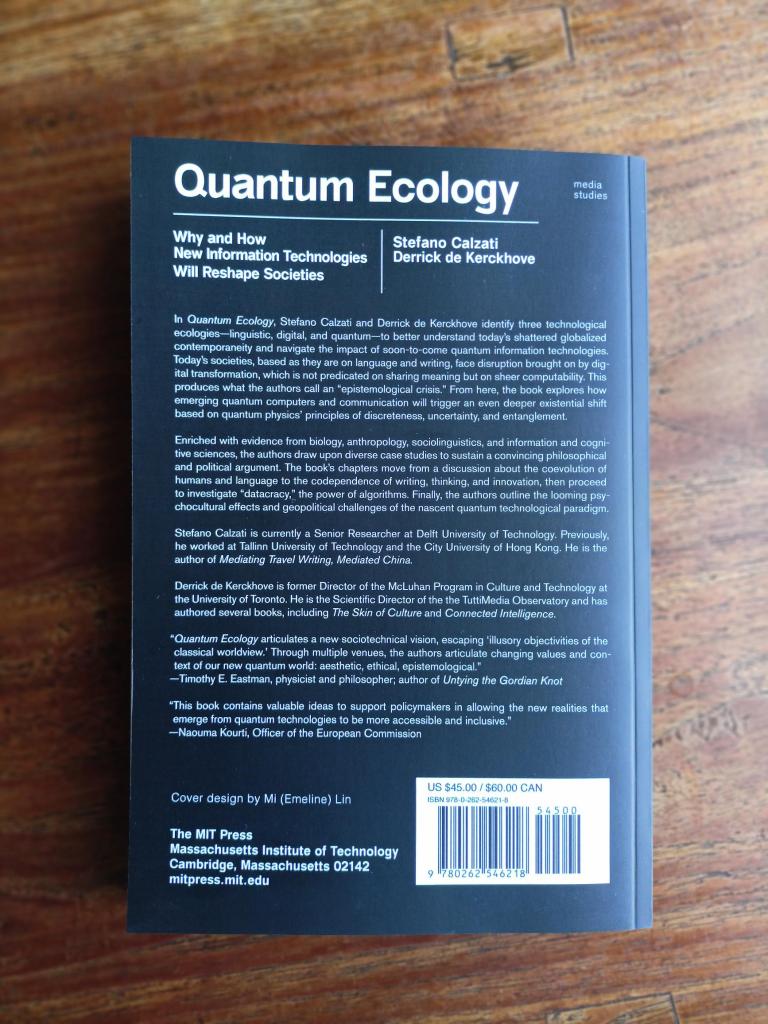
Today, 12th November, the book “Quantum Ecology: Why and How New Information Technologies Will Reshape Societies”, which I co-authored together with prof. Derrick de Kerckhove over the last six years, is released open access by MIT Press.
Credits for the cover go to great researcher and artist Mi (Emeline) Lin.
In this book, we make a case for the emergence of the quantum ecology as both an epistemological framework based on key principles and phenomena of quantum physics – e.g., uncertainty, entanglement, discreteness – and a technological paradigm, pivoting around the development of quantum information technologies (QITs), such as quantum computers and quantum networks. Inscribing the development of QITs along the axis connecting oral communication, writing systems, and data technologies (including AI), we explore why and how the quantum ecology will redefine sense-making alongside and in contrast with other ecologies (of the body, of language, and of the “datum”).
The book is transdisciplinary in nature and maintains an information-theory standpoint to outline a theory of open reality. Quantum physics tells us that a unique, objective reality does not exist; what exists – we claim – are dispositif-dependent ecologies, intended as sociotechnical processes that shape self-organizing world-sensing – enacted through embodiment, operationalized via specific operating systems, and articulated in different technocultural fields – which repeatedly overlap and conflict within and across themselves, coupling individual and collective dimensions in a mutually implicated order of emergence. This led us to identify (some of) the looming psychocultural effects and governing challenges of the nascent quantum ecology, configuring a journey, at once, philosophical and political articulated into various fields (e.g., education, economy, communication, design of complex systems, the arts).
The quantum ecology will concern us all and we will need a plurality of ways of sensing and doing that will allow to shape it fairly and sustainably.
Here some extracts:
“The act of observing/measuring is consubstantial to the coming into being of physical reality. (…) This means that any living organism is always already in a condition of ‘observership’; such an organism is therefore technological for the very fact of living.”
“Being self-organizing, ecology, like quanta, has effects, but not causes, at least not causes in the ordinary sense of a direct relationship between cause and effect.”
“The open-ended fact of simply living, intended as an immanent and non-predetermined process, repeatedly finetunes with the environment and orients, summons, and ultimately actualizes certain physical instantiations, based on certain psychophysical needs, and in view of certain goals. To live is, first of all, a matter of ecological dispositions, of ‘search and see’ as a unique entangled whole.”
“Deep fakes are real and false at the same time: of course, their disentanglement is (still) possible (with a good dose of criticism), but this is beyond contention. Deep fakes, indeed, bypass reason by leveraging on (the fascination of) being ‘paradoxical’, just another possible opinion, which is appealing for the very fact of destabilizing the known in favor of the probable.”
“The kairological dimension of the datafield is precarious, a fundamentally insecure time, a time that does not unfold but simply happens.”
“Humanity lingers on uncertainty; humanity lives in uncertainty. This uncertainty is not (only) epistemological or historical (the uncertainty about the future or the past), it is constitutive of life.”
“Physical reality is discontinuous, discrete, and this is exactly what makes it ontologically generative. This discontinuity is infinitely reworked in kaleidoscopic ways whereby the particularities making up totality cut through this latter and actualize it. Tout se tient: past and future, here and there, “I” and “Other.” Everything is generative (by) differentiation: nature does not exist as a given; it cannot stay still.”
“The quantum ecology is fundamentally communitarian, although not in the sense this term is usually understood. People tend to think of community as a “positive” concept, a gathering together, based on common goals (or even properties), but in fact community is a “negative” concept: it derives for cum + munus (‘duty together’), denoting a bond among people based on necessity. In other words, the communitarian bond rests on a gap, a fundamental condition of deficiency. Humanity can be self-sufficient only as a whole.”
“Increasing quantum computing power will bring increased modularization, transferability, and replicability of experience, intended as enveloped sets of rules, variables, and embedded values to be performed in dislocated scenarios. Quantum computing, then, will allow moving a step further toward the technologization of the ethos of the real, as a synthesis of (individual) minds and (collective) bodies.”
“Our suggestion is that QIT’s management — their development, implementation, and use — should be one based on a republican approach. A quantum republic envisions roles, rules, and mechanisms to keep the whole ecology in balance. To design a republican approach for QITs means to realize a decentralization of the control of these technologies and a systemic distribution of the oversight processes concerning their implementation (and possibly development), to make them it as resilient as possible.”

 Stefano Calzati
Leave a comment