
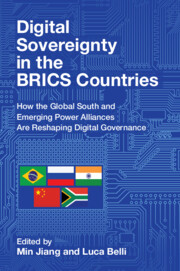
I am very glad to announce that the book Digital Sovereignty in the BRICS Countries: How the Global South and Emerging Power Alliances Are Reshaping Digital Governance is finally out, by Cambridge University Press.
Edited by Min Jiang (University of North Carolina) and Luca Belli (Fundação Getulio Vargas Law School), the book contains a chapter I wrote, titled “A modulated approach to digital sovereignty: exploring Huawei-led smart city initiatives in South Africa and Italy.”
The book is open access (from December 2024 onwards).
Abstract. The chapter is framed within the broad and multi-layered issue of China-Africa relations in the context of Information and Communication Technologies (ICTs). At such a juncture, it becomes particularly relevant to unpack the geopolitical and tech-dependent power relations between two BRICS countries—China and South Africa—in the context of smart city initiatives. The Huawei OpenLab in Johannesburg is chosen for the study, with a similar initiative from Cagliari, the capital of Sardinia, Italy used as a comparison. The goal is to explore the extent to which bilateral cooperation between China and South Africa in constructing smart cities can be said to empower all actors involved, especially South African actors and citizens, rather than (re)producing power asymmetries within a South-South geopolitical context. Further, the chapter offers a better understanding of how Huawei-led smart city initiatives are conceived by scrutinizing their discursive framing, exploring the extent to which the tech giant actions can be deemed as an example of corporate digital sovereignty. The chapter also sheds light on the governance model of these smart city initiatives, with particular attention paid to Huawei’s partnerships and the management of data lifecycle.
Takeaway: Huawei shows high contextual flexibility when establishing its investments and partnerships abroad. The proprietary approach Huawei favours in South Africa undoubtedly gives the company more discretion with regard to the type of projects developed. The diversity of stakeholders with whom Huawei partners, particularly in Italy, does highlight the extent to which its smart city initiatives rework the concept of digital sovereignty and how, beyond theory, it fosters a certain real-political form of digital sovereignty based on contextual opportunities. Beyond a domestic and foreign dichotomy, these smart city initiatives rearticulate the concept of digital sovereignty according to a transnational approach, underscoring Huawei’s modulated interventions across the globe.
Enjoy!
 Stefano Calzati
Leave a comment