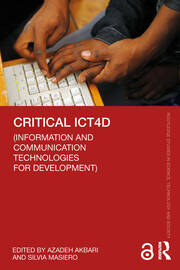
The book Critical ICT4D (Information and Communication Technologies for Development) edited by Azadeh Akbari (University of Twente) and Silvia Masiero (University of Oslo) is finally out, open access, by Routledge.
I contributed to the volume with a chapter titled “From Data Governance to Data Ethics: Invoking Epistemological Plurality for Enabling a Critical Turn in ICT4D”
Abstract: This chapter contributes to the Critical Information and Communication Technologies for Development (ICT4D) research in three ways. First, from within the field of critical data studies, the chapter reflects on the findings from four studies conducted at the Data Lab at Tallinn University of Technology. These studies explored various forms of social datafication, bringing to light the necessity to rethink data governance beyond its current normative standpoint towards the idea of data governance as a practice requiring ongoing negotiation among data experts, data subjects, and their context. Second, the chapter problematises such a conclusion, digging deeper into its ethical and epistemological foundations. This highlights the need for a relativisation of the kind of quantitative knowledge-as-fact imposed by the “datum” in favour of the recognition and cohabitation of other qualitative epistemologies. Third, the chapter takes up the challenge to operationalise this last insight by describing a course in data ethics for the city whose conceptual pillars were a sociotechnical understanding of data-driven technologies and a non-axiomatic, non-normative understanding of ethics.
Takeaway: the chapter builds upon, on the one hand, the work part of the book Quantum Ecology in which we explore the epistemological power, synergies, and tensions among different sense-making ecologies, and, on the other hand the course in data ethics for the city I taught for 3 years at TU Delft. From here, “epistemological plurality” emerges as both a concept and a method of enquiry. As a concept, it stands for the recognition, based on an ecological understanding of the human-technology relation, of our ever-contingent and ever-from-within sense-making of the world, which mixes dispositifs and requires to maintain an open stance toward the (im)possible and our blind spots as individuals and collectives. As a method, “epistemological plurality” demands to explore, via a transdisciplinary approach, the tensions and synergies arising at the intersection of diverse claims and stances, in view of a more inclusive (not relativistic) acceptance of different forms of sense-making.
Enjoy!
 Stefano Calzati
Leave a comment