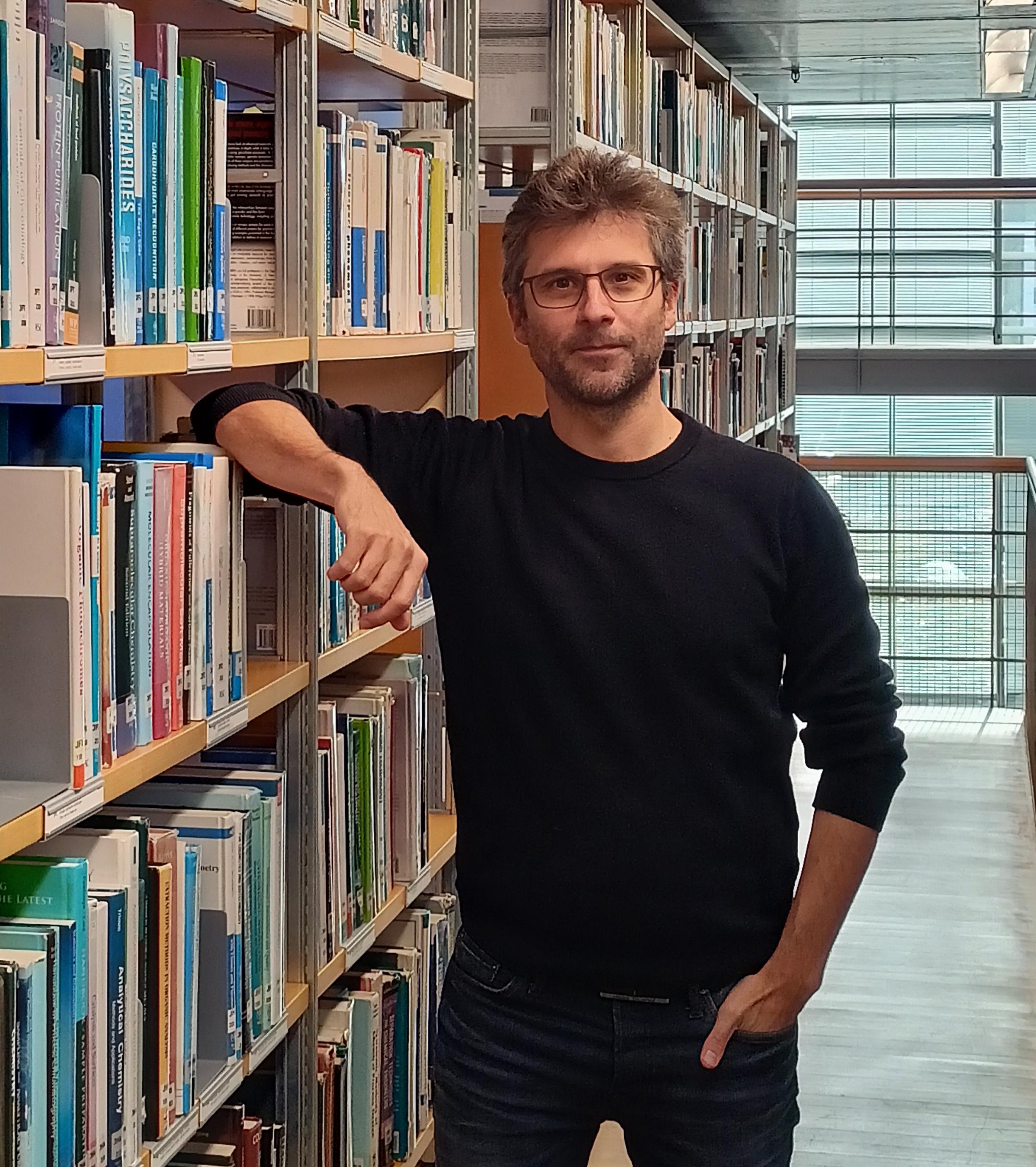
Last 26th and 27th of January, I had the pleasure to attend the concluding event of the Horizon2020 Solaris Project, at Utrecht University, on Generative AI and disinformation.
Chaired by Prof. Federica Russo (project coordinator), and together with other great speakers such as Manuel Gustavo Isaac (GESDA Global), Wakanyi Macharia-Hoffman (Inclusive AI Lab) Antonio Carnevale (Università degli Studi di Bari), I contribute to the roundtable Founding the Future of Digital Society: “Planetarised Humanity”, “Quantum Ecology”, and “Humanist Ethics”.
I contributed with my two cents by discussing the technicity of being and how the quantum ecology (here) can help navigate ontological uncertainty, blurred epistemic lines, overlapping ethical values, and fractal identities and governmentalities.
Here a few key ideas I formulated, based on the broad questions addressed in the roundtable.
In a world that is becoming increasingly techno-oriented, what will happen to our ‘human status’?
We’ll need increasing legitimation of and adaptation to agentic co-worlding (it has always been the case, but we have removed/sidelined this), i.e., a quantum onto-epistemological framing. Provocation: the human is and has always been “technical” in the sense of a being that is symbiotically co-determined. We need an ecological approach, not only in the sense of being open to the environment, but in the sense of the recognition and operationalization of a systemic condition of fundamental necessity, uncertainty, and entanglement among its actors, both living and artificial, individual and collective (or “collectual”), as much as these categories hold.
What will keep us human, and is it important?
Human is never about the individual, it’s about a collectively shared condition. We often hear that we must keep the digital transformation human-centric, but what the digital transformation has brought forth is a formatting of the sensible, which tends to zero sociocultural thickness and diversity in exchange for putting, so to speak, the whole of humanity on the same (0 and 1) page. But this computable page has turned out to escape human meaningfulness, and, especially, to be not as controllable and efficient as we expected. The merging of AI and quantum information technologies, for instance, we create synthetic hyper-phenomenological realities demanding us to think and act in terms of the probable and the co-existence of epistemic inconsistencies. So, more than remaining human, let’s become ecological, i.e., accepting our dethroned role, the loss of absolute certainties, and the attuning to “unprestatable” (Kauffman 2019) complexities (either physical and/or digital, organic and/or artificial).
What are the ethical and anthropological foundations for a digital society?
- Defense and legitimation of epistemic diversity (body, language, data, images, etc.), external dissonances, and internal inconsistencies
- Accommodation of fundamental uncertainty (an attitude of flexibility and openness to change and adaptation)
- A non-axiomatic understanding of value (beyond “good vs bad”) informing ethics (here)
What do we need to develop to make this ‘Planetarised Humanity’ possible?
Rescuing, as much as possible, trust in and effectiveness of international organizations – although we are going quite in the opposite direction right now! Yet, “planetarised” does not exclude forms of federation.
Re-introduce a non-ideological discussion on the possibility of putting guardrails to tech innovation (including bans), not due to an a-priori rejection of technology, but because more and more often tech innovation is a black-boxed process and one that is increasingly misaligned with sociocultural readiness: as a collective, we are literally outpaced (psychologically, physiologically, and socially) by tech advancements. Plus, guardrails can actually be beneficial to innovation if they manage to fuel a fairly competitive ecosystem.How can less ‘tech-savy’ teach future and more ‘tech-savy’ generations?
This is key: as teachers, we are the last generation that has witnessed the analogue and the advent of the digital. We keep our feet in two epochs. We must teach to digital-born generations that the acquisition and production of knowledge does not come as easily as a click. I’m not a fan of the idea that learning must be a painful process, but it is a process nonetheless! From an evolutionary point of view, our brain needs procedural time for acquisition and learning.
 Stefano Calzati
Leave a comment